

Droven IO AWS vs Azure Comparison: A Real Look at Both Clouds
Picking a cloud platform feels hard. AWS and Azure both look good on paper. But they work very differently in real life. That is why doing a proper droven io aws vs azure comparison before you spend money is so important. This article gives you a clear, honest look at both. No fluff. Just the stuff that actually matters.
Let Us Start With the Basics
AWS stands for Amazon Web Services. Amazon built it. It launched in 2006. It was the first big cloud platform. A lot of companies built their entire tech stack on it early on.Azure is Microsoft’s cloud. It launched in 2010. Microsoft pushed it hard to enterprise companies. They already had millions of businesses using Windows and Office. Azure plugged right into that world.
Both clouds are reliable. Both are used by huge companies. But picking the wrong one for your needs wastes time and money. A good droven io aws vs azure comparison helps you avoid that.
What Is Droven IO and Why Does It Matter Here
Droven IO is a cloud management platform. It lets you control multiple cloud environments from one place. You can connect AWS and Azure to Droven IO and manage both together.That is a big deal. Most companies do not live on just one cloud anymore. They spread workloads across AWS and Azure depending on the job. Droven IO ties it all together.
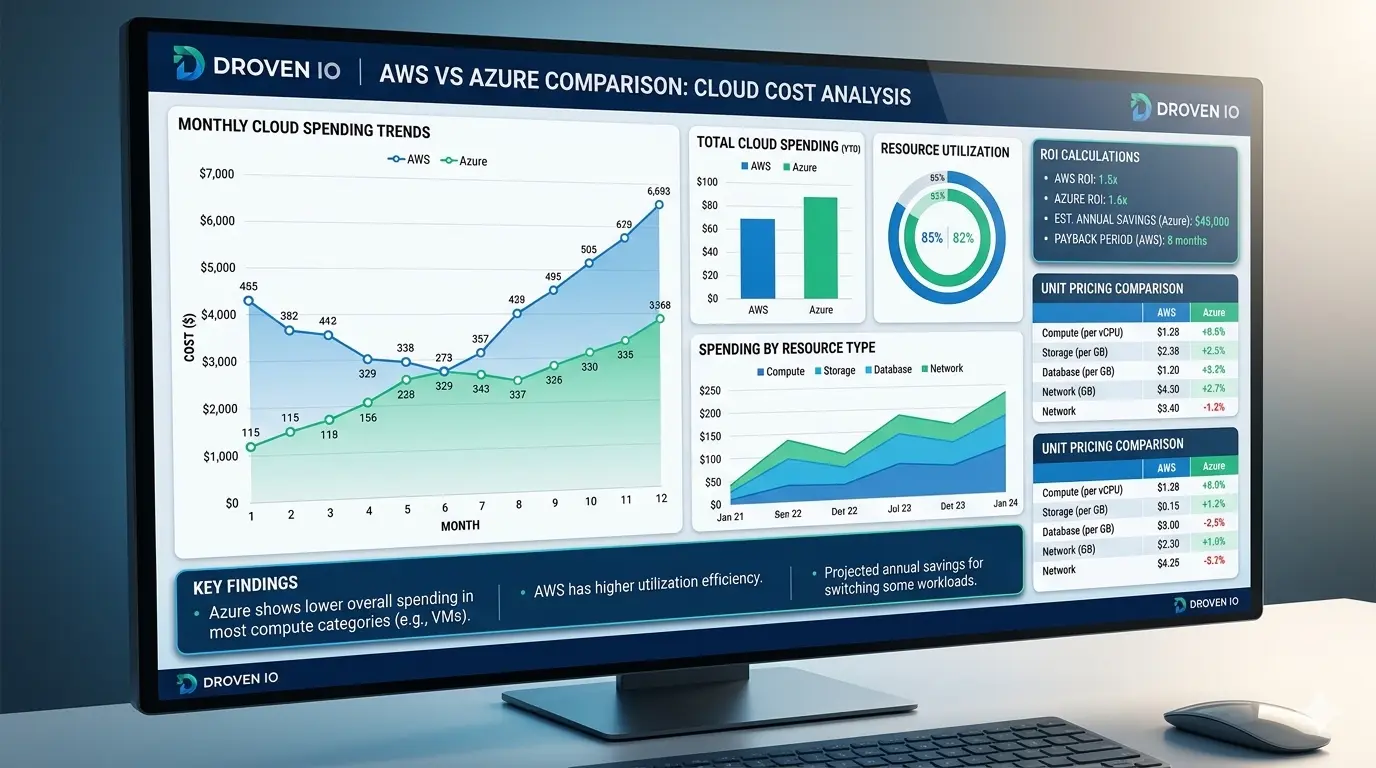
So when you do a droven io aws vs azure comparison through the platform, you are not just reading a spec sheet. You are looking at real usage data from your own account. That makes the comparison much more useful.
Compute Power: Running Your Apps
Compute means the processing power you rent to run your apps and workloads.AWS calls its compute service EC2 (Elastic Compute Cloud). You pick a virtual machine size and pay for what you use. There are hundreds of instance types. That is good because you can tune exactly what you need. But it is also a lot to learn at the start.
Azure calls its compute service Azure Virtual Machines. It works very similarly to EC2. The difference is Azure VM sizes connect more naturally to Microsoft tools. If your app runs on Windows Server or .NET, Azure VMs feel smoother to set up.For Linux workloads, both perform well. For Windows workloads, Azure tends to be cheaper and easier. That pattern shows up a lot in the droven io aws vs azure comparison data.
Storage: Keeping Your Data Safe
Both clouds offer object storage, block storage, and file storage.
AWS uses S3 for object storage. It is one of the most used storage services in the world. It is reliable, fast, and flexible. Millions of websites store images, videos, and backups on S3.
Azure uses Blob Storage for the same job. It works well too. Pricing is slightly lower per GB on Azure in some tiers. But AWS S3 has more features and a bigger ecosystem of tools built around it.
For databases, both offer managed options. AWS has RDS, DynamoDB, and Aurora. Azure has Azure SQL Database, Cosmos DB, and more. If you already use SQL Server, Azure SQL is a natural fit. It is basically SQL Server in the cloud.
Pricing Breakdown
This is where the droven io aws vs azure comparison gets really practical.
| Service Category | AWS | Azure | Winner |
|---|---|---|---|
| Linux Virtual Machines | Slightly higher | Slightly lower | Azure |
| Windows Virtual Machines | Higher | Lower (Hybrid Benefit) | Azure |
| Object Storage (per GB) | $0.023 | $0.018 | Azure |
| Outbound Data Transfer | Charges apply | Charges apply | Tie |
| Free Tier Duration | 12 months + always free | 12 months + some always free | Tie |
| Spot/Low Priority VMs | Available | Available | Tie |
| Reserved Instances | 1 or 3 year options | 1 or 3 year options | Tie |
| Machine Learning Tools | Strong | Strong | Tie |
| Hybrid Cloud Pricing | Basic | Azure Hybrid Benefit | Azure |
| Support Plans | Multiple tiers | Multiple tiers | Tie |
Azure wins on raw pricing in several areas. But AWS often wins on flexibility. You can optimize AWS costs heavily if you know what you are doing. Droven IO helps with this by showing your actual spend across both platforms in one view.
Networking: Moving Data Around
Networking is how your data travels between services and to your users.
AWS uses a system called VPC (Virtual Private Cloud). You create private networks inside AWS. You control who can talk to what. It is powerful but takes time to learn well.
Azure uses Virtual Networks (VNet). It works similarly. But Azure VNet connects more naturally to on-site networks. If you have a physical office with servers, connecting to Azure is usually easier.
For content delivery, AWS has CloudFront. Azure has Azure CDN. Both push your content closer to users around the world. Both work well. CloudFront has more locations globally right now.A droven io aws vs azure comparison on networking usually comes down to one question. Do you have existing on-site infrastructure? If yes, Azure is likely easier to connect. If you are cloud-only, AWS gives you more options.
Developer Tools and Workflow
Developers care about how fast they can build and ship. Both clouds have strong tools for this.
AWS has CodePipeline, CodeBuild, and CodeDeploy. These tools handle your build and release process. They work well but feel a bit disconnected from each other sometimes.
Azure has Azure DevOps. It is one integrated platform for planning, coding, building, testing, and deploying. If your team uses GitHub, Azure DevOps connects to it very smoothly. Microsoft owns GitHub now so the integration is tight.
For serverless computing, AWS has Lambda. Azure has Azure Functions. Both let you run code without managing servers. AWS Lambda has been around longer and has a bigger community. Azure Functions works better inside the Microsoft ecosystem.Thelaptopadviser expert gaming style recommendation here would be: pick the tools your team already knows. Switching workflows costs more than any cloud price difference.
Machine Learning and AI Tools
Both clouds are investing heavily in AI and machine learning right now.
AWS has SageMaker. It is a complete platform for building, training, and deploying machine learning models. It has a large user base. Lots of tutorials and community support exist for it.
Azure has Azure Machine Learning. It integrates well with Microsoft tools like Power BI and Azure Synapse Analytics. If your data team already uses Microsoft products, Azure ML feels natural.
Both now offer access to large language models and AI services. AWS has Bedrock for accessing foundation models. Azure has Azure OpenAI Service which gives you access to GPT models from OpenAI. That is a big deal for companies building AI-powered apps.
In a droven io aws vs azure comparison focused on AI work, Azure has an edge right now because of the OpenAI partnership. But AWS is catching up fast.
Security: Keeping Things Locked Down
Security is not optional. Both clouds take it seriously.
AWS has a huge set of security tools. GuardDuty detects threats automatically. Macie scans for sensitive data. Security Hub gives you one view of your security posture. AWS Shield protects against DDoS attacks. These tools are powerful but you have to set them up yourself.
Azure has Microsoft Defender for Cloud. It monitors your environment and gives you security recommendations. It works across Azure and even on-site servers. Azure also has strong identity tools through Azure Active Directory. If your company already uses Active Directory, this plugs right in.
For compliance, both meet major global standards. HIPAA, GDPR, ISO 27001, SOC 2 and more. Azure has slightly more government-specific certifications. That matters for public sector work.The droven io aws vs azure comparison on security really depends on your setup. Microsoft-heavy companies feel more at home with Azure security tools. Cloud-native companies often prefer AWS for the depth of options.
Reliability and Uptime
Both AWS and Azure promise high uptime. They both offer service level agreements (SLAs) with 99.9% or higher uptime for most services.
AWS has more availability zones per region. That means more backup locations if something goes wrong. AWS regions are also more mature. They have been running longer and have fewer surprise outages.
Azure has more total regions around the world. Over 60 regions compared to AWS which has around 30 to 33. But Azure regions vary in size and maturity. Some newer regions have fewer services available.
For most businesses, both are reliable enough. Pick the region closest to your users. That matters more than which cloud you are on.
Hybrid Cloud: Mixing Old and New
Many companies still have servers in their own offices or data centers. They cannot move everything to the cloud overnight. That is normal. Hybrid cloud connects your on-site setup to the cloud.
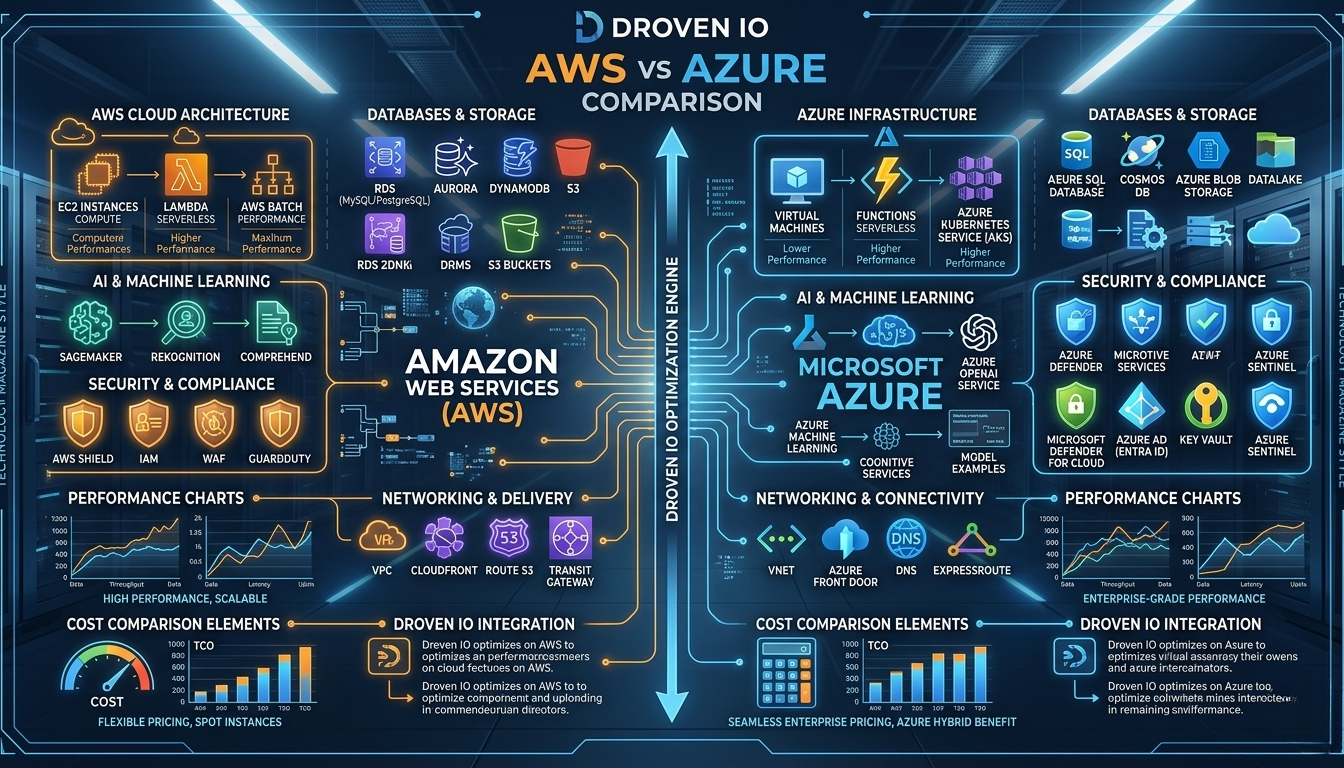
Azure is better at hybrid cloud. Full stop. Azure Arc lets you manage on-site servers alongside cloud servers from one place. It works with Windows, Linux, and Kubernetes clusters. Microsoft built Azure with enterprise customers in mind from the start. Hybrid was always part of the plan.
AWS has AWS Outposts. It brings AWS hardware into your data center. It works well but it is expensive and takes more setup time. It is more of a full commitment than a flexible bridge.
If hybrid cloud is a priority for your company, the droven io aws vs azure comparison clearly points toward Azure.
Which Companies Use What
Knowing who uses each cloud helps you understand the culture and support around each.
AWS is used heavily by startups, tech companies, media companies, and ecommerce businesses. Netflix, Airbnb, Spotify, and NASA all run on AWS. The developer community around AWS is massive.Azure is used heavily by enterprises, financial institutions, healthcare companies, and government agencies. Boeing, Walmart, and many Fortune 500 companies run on Azure. If you work in a big traditional industry, you will find more people who know Azure.A droven io aws vs azure comparison inside large enterprises often ends with a mix of both. Azure for internal business apps and Windows workloads. AWS for customer-facing apps and developer tools.
Making Your Decision
Here is a simple way to think about it.
Pick AWS if your team is developer-focused. If you want the biggest library of services. If you are building a startup or a consumer product. If your team already knows AWS tools.
Pick Azure if your company runs Windows or SQL Server. If you need hybrid cloud support. If you use Microsoft 365 or Active Directory. If you work in healthcare, finance, or government.
Use Droven IO if you want to use both without the headache. The droven io aws vs azure comparison inside Droven IO gives you real data from your actual usage. You see costs side by side. You manage resources in one place. You make smarter decisions faster.
Wrapping Up
AWS and Azure are both great clouds. Neither is perfect. Both have things the other does not. The right choice depends on your team, your existing tools, and your budget.The droven io aws vs azure comparison is not just a thought exercise. It is a practical tool. Use Droven IO to run both clouds and compare them with your real workloads. That is how you find the answer that actually fits your situation.Stop reading specs in isolation. Start comparing real numbers. Use Droven IO and make a cloud decision you will not regret.
FAQs About Droven IO AWS vs Azure Comparison
What is Droven IO and how does it help with AWS and Azure?
Droven IO is a cloud management platform. It connects to both AWS and Azure and lets you manage them from one dashboard. You see your costs, resources, and usage all in one place. Instead of switching between two different consoles, you handle everything inside Droven IO. That makes the droven io aws vs azure comparison much easier because you are working with your own real data.
Is AWS or Azure better for a company that uses Microsoft products?
Azure is the better pick here. If your company runs Windows Server, SQL Server, or Microsoft 365, Azure connects to all of that smoothly. You can reuse your existing licenses through the Azure Hybrid Benefit. That saves real money. AWS works fine with Microsoft products too but it takes more setup and costs more to run Windows workloads on it.
Which cloud is easier to learn for beginners?
Both have a learning curve. AWS has more services which can feel overwhelming at the start. Azure feels more familiar if you already use Microsoft tools. For someone brand new to cloud with no Microsoft background, AWS has more free tutorials and a bigger community to learn from. Either way expect to spend some time learning before things click.
Can I use both AWS and Azure at the same time?
Yes and many companies do exactly that. They run some workloads on AWS and others on Azure depending on what works best. This is called a multi-cloud setup. Droven IO makes this much easier to manage. Without a tool like Droven IO, juggling two clouds gets messy fast. The droven io aws vs azure comparison feature helps you decide which workload belongs on which cloud.
Which cloud is better for AI and machine learning work?
Both are strong but Azure has a notable edge right now. Azure has a deep partnership with OpenAI. That means you get access to GPT models directly through Azure OpenAI Service. If your team is building AI-powered apps, that is a big advantage. AWS has SageMaker and Bedrock which are solid tools too. But the OpenAI connection gives Azure something AWS cannot match at the moment.